Introduction
A prompt engineering course for beginners is valuable only if it teaches thinking patterns, not just prompt templates. As AI tools become mainstream, many beginners rush into courses expecting instant mastery—only to discover recycled prompts, vague theory, or content that feels impressive but doesn’t translate into real results.
From hands-on experience, beginners don’t fail because they “don’t know prompts.” They struggle because they don’t understand how AI responds to instructions, how intent shapes output, and how to debug poor results. This article explains what a beginner prompt engineering course should realistically cover, what skills you’ll gain, what it won’t teach you, and how to choose a course that actually builds usable ability—not false confidence.
What prompt engineering really means (for beginners)
Prompt engineering is not about memorizing clever phrases. At its core, it’s the skill of:
Framing instructions clearly
Providing the right amount of context
Setting constraints and expectations
Iterating based on output quality
A beginner course should focus on reasoning and structure, not shortcuts.
What a good beginner prompt engineering course covers
A quality beginner course usually teaches the following foundations:
1. How AI interprets instructions
Why vague prompts fail
How specificity changes output
The role of context and examples
2.Prompt structure basics
Instruction → context → output format
When to use constraints
How to avoid conflicting instructions
3.Iteration and refinement
Evaluating responses
Improving prompts step by step
Knowing when prompts—not the model—are the issue
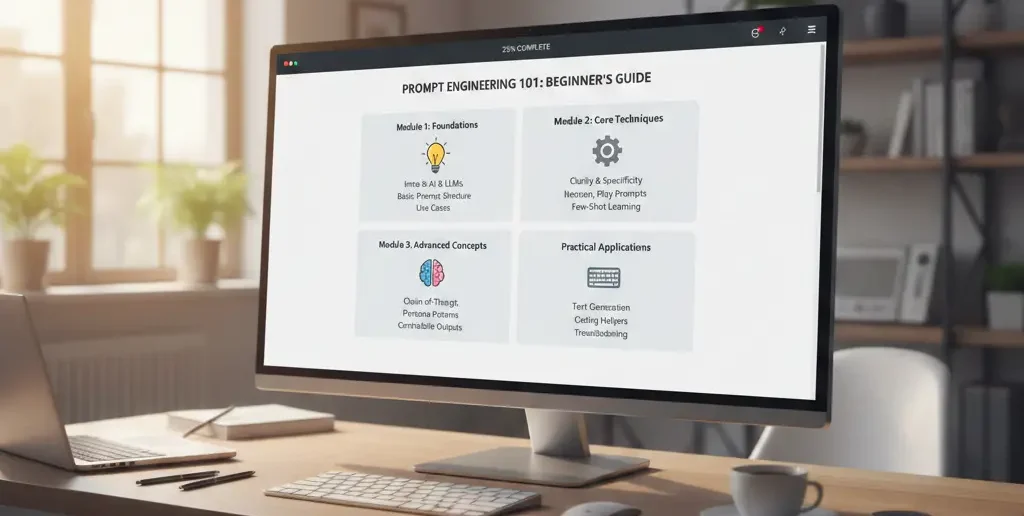
A realistic beginner learning path (example)
| Stage | Skill Focus | Outcome |
| Week 1 | Prompt clarity | Fewer irrelevant answers |
| Week 2 | Context control | More accurate responses |
| Week 3 | Output formatting | Reusable workflows |
| Week 4 | Debugging prompts | Consistent results |
This progression reflects how people actually learn—not how courses market themselves.
Common beginner mistakes (and how courses should fix them)
Mistake 1: Collecting prompts instead of understanding them
Fix: Courses should explain why a prompt works.
Mistake 2: Expecting AI to read minds
Fix: Teach explicit instruction writing.
Mistake 3: Blaming the model for bad output
Fix: Teach prompt debugging techniques.
[Expert Warning]
Courses that promise “mastery in one hour” usually skip the thinking skills that matter most.
Information Gain: What most beginner courses don’t explain
Here’s a key insight many courses miss:
Prompt engineering is transferable across tools.
Beginners are often taught prompts tied to one platform. In practice, the real skill is learning how to adapt prompts when tools, models, or interfaces change.
A strong beginner course teaches:
Prompt principles
Adaptation strategies
Tool-agnostic thinking
This future-proofs your learning.
Unique section — Beginner mistake most people make
Most beginners assume better prompts mean longer prompts. In reality, from practical use, overloaded prompts reduce clarity.
Short, well-scoped prompts often outperform long instructions filled with rules. A good course teaches restraint—not verbosity.
How to evaluate a beginner prompt engineering course
Before enrolling, check whether the course includes:
Hands-on exercises (not just videos)
Real use cases (writing, research, analysis)
Prompt debugging examples
Feedback or iteration guidance
If everything is theoretical, skill development will be slow.
(FAQs)
Is a prompt engineering course worth it for beginners?
Yes, if it teaches principles, not just templates.
Do beginners need coding skills?
No. Clear thinking matters more.
How long does it take to learn basics?
A few weeks with practice.
Are free courses enough?
They help, but structured courses go deeper.
Can prompt engineering skills transfer across tools?
Yes, that’s a core benefit.
What’s the biggest beginner mistake?
Copying prompts without understanding them.
Conclusion
A prompt engineering course for beginners should build understanding, adaptability, and confidence, not just provide a list of prompts. From real-world experience, beginners succeed when they learn how to think with AI, not how to impress it.
If a course helps you reason, refine, and adapt prompts across tools, it’s doing its job.
Internal link
Prompt Engineering Courses with Hands-On Projects (2026 Guide)
External link
https://www.coursera.org/specializations/prompt-engineering?