Introduction
A prompt engineering course for marketers is only useful if it improves outcomes—better briefs, clearer messaging, faster testing—not just prettier prompts. Marketing teams are under pressure to produce more content, analyze feedback quickly, and adapt campaigns across channels. AI can help, but only when prompts are designed around marketing intent, not generic AI tricks.
From hands-on work, marketers who benefit most from prompt engineering aren’t those who memorize prompt templates. They’re the ones who learn how to translate campaign goals into constraints, guide AI toward brand-safe outputs, and evaluate results with a marketer’s eye. This guide explains what a marketing-focused prompt engineering course should teach, where many courses fall short, and how to choose training that actually pays off in daily work.
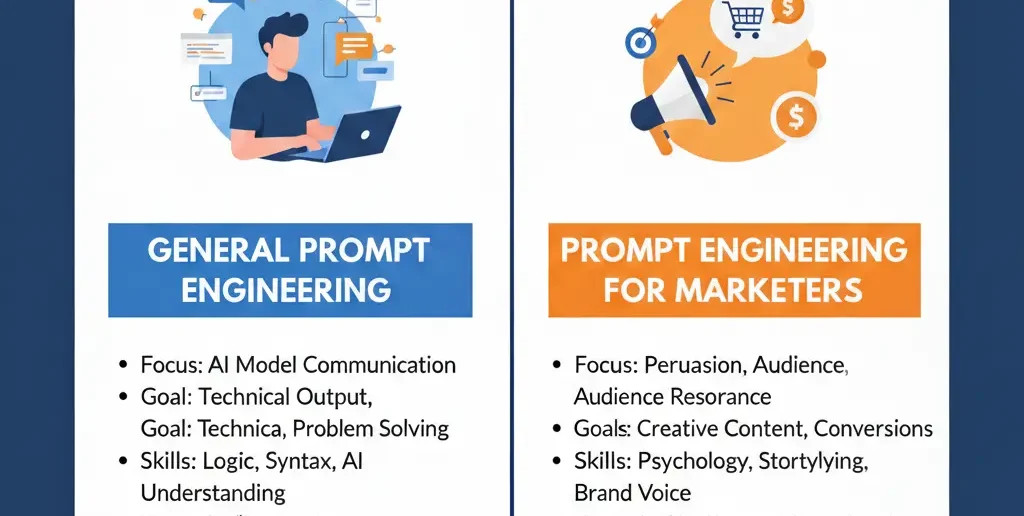
What makes prompt engineering different for marketers
Marketing prompts differ from general prompts in three key ways:
Audience specificity — messaging must adapt to segments, stages, and channels
Brand constraints — tone, claims, and compliance matter
Iteration speed — prompts must support rapid testing, not one-off outputs
A strong course addresses all three.
Core skills a marketer-focused course should teach
1) Translating marketing goals into prompts
From objective (CTR, clarity, conversions) to instructions
Turning personas into constraints
Defining success criteria before generating text
2) Channel-aware prompting
Email vs landing pages vs ads
Short-form vs long-form constraints
Platform-specific tone controls
3) Evaluation and iteration
Identifying “on-brand but off-intent” outputs
Refining prompts without inflating length
Knowing when to stop iterating
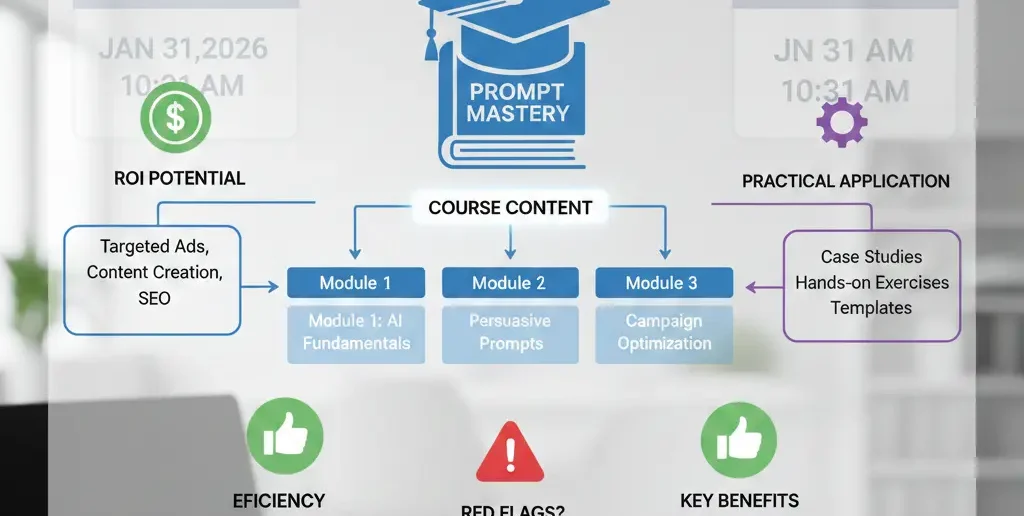
Typical modules you should expect
| Module | What You Learn | Why It Matters |
| Campaign briefs | Structured prompting | Faster alignment |
| Copy variations | Constraint-driven outputs | Better testing |
| Messaging frameworks | Consistency at scale | Brand safety |
| Feedback loops | Iteration methods | Quality control |
Courses missing evaluation modules often leave marketers guessing.
Common mistakes marketers make in prompt courses
Mistake 1: Treating prompts like copy
Fix: Prompts are instructions, not deliverables.
Mistake 2: Overloading prompts with brand rules
Fix: Use layered prompts—core goal first, constraints second.
Mistake 3: Chasing novelty
Fix: Optimize for clarity and fit, not cleverness.
[Expert Warning]
Courses that promise “viral copy on demand” often skip the review and compliance steps marketers actually need.
Information Gain: The gap most marketing courses miss
Most courses focus on generation. What they miss is selection.
From practical campaigns, the real advantage comes from prompting AI to:
Compare variants against goals
Explain trade-offs (clarity vs persuasion)
Flag claims that need substantiation
Selection-focused prompt example
“Compare these three variants against the campaign goal of clarity for first-time users. Identify risks and suggest a safer alternative.”
This turns AI into a reviewer—not just a writer.
Unique section — Practical insight from experience
Teams that succeed with AI in marketing build a prompt playbook: a small set of tested prompts tied to recurring tasks (briefs, headlines, summaries). Courses that help you build your own playbook create lasting value; those that hand out generic prompts don’t.
How to evaluate a prompt engineering course for marketers
Before enrolling, check for:
Real marketing scenarios (emails, landing pages, ads)
Brand and compliance considerations
Variant comparison and evaluation
Guidance on prompt reuse across campaigns
If everything looks tool-centric, expect limited transfer.
(FAQs)
Do marketers need a specialized prompt course?
Yes, because constraints and evaluation differ from general use.
Are prompts reusable across campaigns?
Yes, with small contextual tweaks.
Does prompt engineering replace copywriting?
No. It augments it.
How long does it take to see ROI?
Usually weeks, not days.
Are these courses beginner-friendly?
Most are, if fundamentals are covered.
What’s the biggest risk?
Publishing without review.
Conclusion
A prompt engineering course for marketers should sharpen thinking, evaluation, and iteration, not just output volume. From real-world campaigns, success comes when AI is guided by clear goals and checked by human judgment.
Choose courses that respect that balance—and you’ll get lasting value.
Internal link
Prompt Engineering Learning Roadmap (Beginner to Advanced) | AidCanvas-2026
External link
https://www.udemy.com/course/prompt-engineering-for-marketers-and-content-creators/?