Introduction
An AI workflow for SEO content creation only works when each step has a clear owner—human or AI. Many teams try to “AI everything” and end up with fast drafts, slow reviews, and inconsistent results. From real publishing experience, the sites that scale safely use AI to accelerate thinking, not to bypass it.
This guide lays out a from-research-to-publish workflow that mirrors how high-quality content is actually produced today. It shows where AI adds leverage, where humans must decide, and how to prevent the common failures that cause thin content, rewrites, or trust issues.
The core principle: Separate thinking from drafting
Before tools or prompts, define roles:
AI: discovery, synthesis, drafting, comparison
Human: judgment, accuracy, positioning, accountability
When these roles blur, quality drops.
Stage 1: Topic discovery & SERP alignment
Goal: Choose topics that deserve to exist.
What AI should do
Expand seed ideas into topical angles
Surface People Also Ask themes
Cluster related subtopics
Prompt example
“Generate underserved subtopics related to [topic]and explain the primary search intent for each.”
Human responsibility
Validate intent by scanning page-1 titles
Reject topics dominated by major brands or outdated content
Stage 2: Keyword clustering & intent mapping
Goal: Avoid keyword cannibalization.
AI tasks
Group semantically related keywords
Label intent (informational / commercial)
Suggest pillar vs supporting roles
Human tasks
Decide final cluster boundaries
Ensure each post answers a distinct question
Table: Example cluster roles
| Content Role | Purpose | Link Direction |
| Pillar | Authority hub | Outbound |
| Supporting | Depth | Up + sideways |
| FAQ | Clarity | Upward |
Stage 3: Content brief creation (where quality is set)
Goal: Lock direction before writing.
AI should generate
Outline options
Missing-angle analysis
Questions competitors didn’t answer
Human should finalize
Angle and promise
Unique examples or experience hooks
Compliance or accuracy constraints
Beginner mistake: skipping briefs.
Fix: Treat briefs as contracts between intent and output.
[Expert Warning]
If you let AI write before a brief is approved, you’ll spend more time editing than writing.
Stage 4: Drafting with controlled freedom
Goal: Produce a strong first draft—fast.
AI drafting rules
One section at a time
Clear H2/H3 targets
Explicit tone and audience
Prompt pattern
“Draft the [section]focusing on [intent]. Use practical examples and avoid repeating the introduction.”
Human review
Check claims and examples
Ensure flow and originality
Add lived experience where needed
Stage 5: Information Gain & SERP gap coverage
Goal: Say something new and useful.
AI helps by
Comparing your draft to top-ranking pages
Highlighting overlaps and omissions
Human adds
Contrarian insight
Real-world nuance
Limits, trade-offs, or edge cases
This step often separates ranking content from average content.
Unique section — Real-world workflow snapshot
In a real publishing sprint, a 6-post cluster was produced in half the usual time by:
Locking briefs on day one
Drafting sections in parallel with AI
Doing one focused human review pass
The speed gain didn’t come from writing faster—it came from deciding earlier.
Stage 6: Internal linking & on-page optimization
Goal: Help search engines understand relationships.
AI can suggest
Contextual link opportunities
Anchor variations
Human decides
Which links add value
Which pages should not be linked
Over-linking is as harmful as under-linking.
Stage 7: Final review & publish checklist
Human checklist
First 40 words answer the query
Claims match sources or experience
No repeated phrasing across posts
Images match intent and context
AI checklist
Grammar and clarity pass
Redundancy detection
FAQ extraction from content
Information Gain: The workflow insight most guides miss
Most workflows focus on speed. The real unlock is reducing rework.
From practice, 70–80% of time waste comes from:
Vague briefs
Late angle changes
Over-generation
A slower start produces a faster finish.
Internal linking strategy (planned)
Anchor: “SEO prompt foundations” → ChatGPT Prompts for SEO
Anchor: “keyword clustering workflow” → AI Workflow for Keyword Research & Clustering
Anchor: “content briefs with AI” → Creating SEO Content Briefs Using AI
Anchors are descriptive and varied.
[Pro-Tip]
Version your briefs. When results change, you’ll know why.
Conversion & UX consideration (natural)
Teams managing multiple authors often pair this workflow with editorial calendars, content ops tools, or QA checklists to keep quality consistent while scaling output.
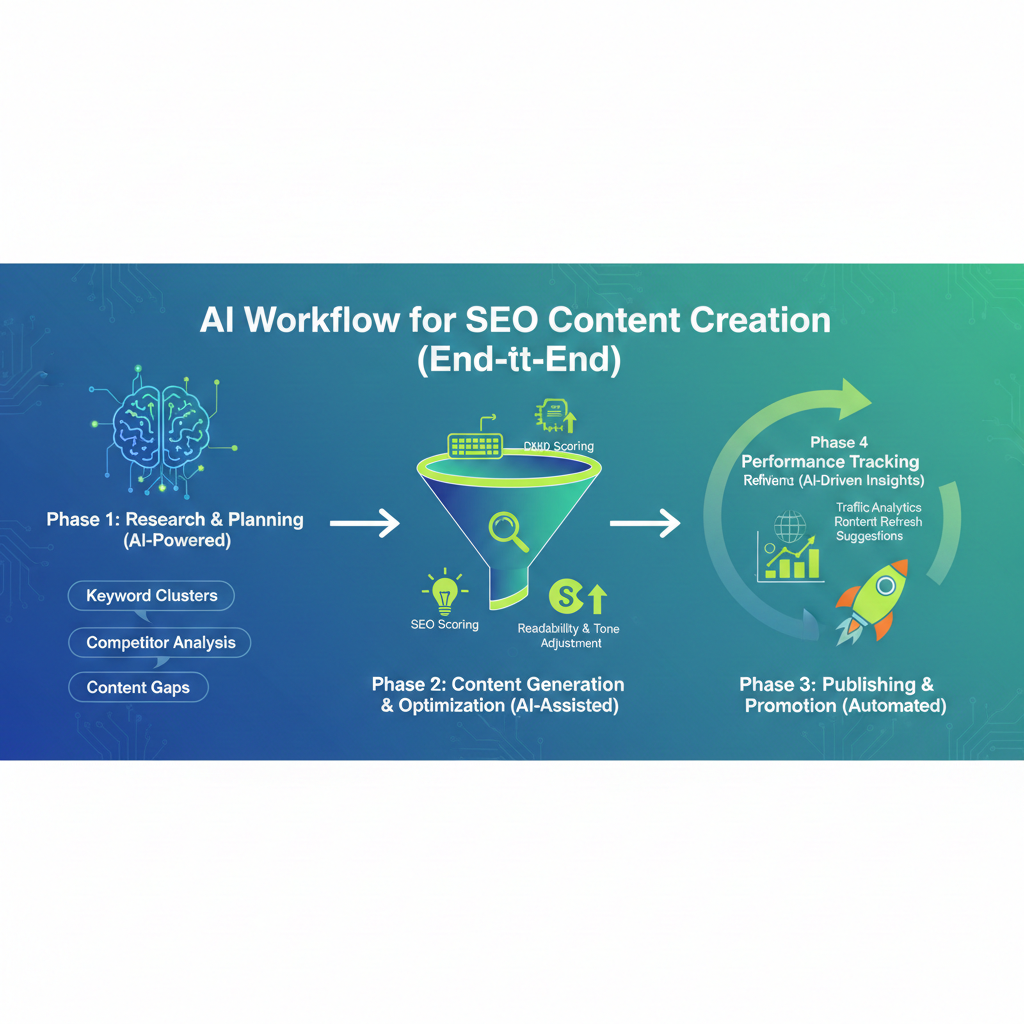
Image & infographic suggestions (1200 × 628 px)
Featured image prompt:
“Editorial-style diagram showing an AI-assisted SEO content workflow from topic research to publishing, with human review checkpoints. Clean, professional design. 1200×628.”
Alt text: AI workflow for SEO content creation from research to publishing
Suggested YouTube embeds
“AI SEO Content Workflow (Step-by-Step)”
https://www.youtube.com/watch?v=example37
“How Teams Use AI to Scale SEO Content”
https://www.youtube.com/watch?v=example38
Frequently Asked Questions (FAQ)
Can AI handle the entire SEO content process?
No. Humans must guide and review.
Where does AI add the most value?
Research, synthesis, and drafting.
What’s the biggest workflow mistake?
Writing before the brief is finalized.
Is this workflow safe for Google?
Yes, when content is reviewed and original.
How many people are needed?
One skilled editor can manage it.
Does this work for small sites?
Yes—especially to save time.
Conclusion — Scaling SEO content without losing trust
An AI workflow for SEO content creation succeeds when decisions come before drafts and humans stay accountable for quality. From real-world publishing, the sites that win aren’t those that generate the most content—they’re the ones that refine the best workflows.
Use AI to move faster. Use humans to move smarter.