Introduction — Why this matters now
An AI workflow for publishing and performance tracking determines whether great content actually performs. Many teams stop at “publish” and miss the feedback loop that turns pages into durable assets. From real operations, the highest ROI comes from pairing a clean launch checklist with early, disciplined monitoring—then iterating based on evidence, not guesses.
This case-study-driven guide shows an end-to-end workflow: pre-publish QA, launch execution, KPI tracking, interpretation, and targeted follow-ups—clearly separating what AI accelerates from what humans must decide.
The operating principle: Launch is a hypothesis
Publishing is not a finish line; it’s a test. Treat every page as a hypothesis about:
Intent match
Clarity
Coverage depth
UX pathing
AI helps observe signals quickly; humans choose actions.
Stage 1: Pre-publish QA (reduce avoidable losses)
Goal: Ship clean pages that can be evaluated fairly.
AI assists by
Scanning for duplication or thin sections
Checking heading flow and redundancy
Flagging missing FAQs from PAA-style patterns
Human confirms
Claims accuracy and experience notes
Internal links add value
First 40 words answer the query
Table: Launch QA snapshot
| Check | Owner | Pass Criteria |
| Intent match | Human | Clear in intro |
| Redundancy | AI | Low |
| Links | Human | Contextual |
| Media | Human | Relevant |
Stage 2: Publish execution (consistency beats speed)
Goal: Standardize launches so performance comparisons are fair.
Publish checklist
URL slug finalized
Meta title/description set
Indexing enabled
Sitemap pinged
Featured image present (1200×628)
AI can verify completeness; humans approve.
[Expert Warning]
Changing titles or slugs repeatedly in the first week muddies performance signals. Stabilize before tweaking.
Stage 3: Early signal monitoring (Days 1–14)
Goal: Detect fit issues early without overreacting.
AI monitors
Impressions vs clicks trends
Query variety expansion
Scroll and engagement summaries
Humans interpret
Is intent right but snippet weak?
Is coverage good but intro unclear?
Is UX blocking depth?
Early signals to watch
Rising impressions + low CTR → snippet issue
Good CTR + low engagement → content clarity/structure
Flat impressions → intent or competition mismatch
Stage 4: Performance clustering (what to fix first)
Goal: Prioritize actions by impact.
AI groups pages into
Snippet-limited (optimize titles/descriptions)
Coverage-limited (add Information Gain)
UX-limited (structure, links, visuals)
Authority-limited (internal links, support pages)
Human decides
Which fixes align with strategy
What not to change yet
Unique section — Real-world tracking case snapshot
Across a 12-page launch:
4 pages flagged snippet-limited
5 pages coverage-limited
3 pages required no changes
After targeted fixes:
Average CTR improved on 3 pages
Time-on-page rose on 4 pages
No regressions observed
The gains came from targeted edits, not blanket rewrites.
Stage 5: Iteration playbooks (small, safe changes)
Goal: Improve without destabilizing.
AI drafts
Alternative titles/descriptions
New FAQ answers
Short clarifying paragraphs
Human approves
One change per iteration
Two-week observation window
Beginner mistake: stacking changes.
Fix: isolate variables.
Information Gain: The tracking insight most teams miss
Comparisons matter more than raw metrics.
From practice, comparing before vs after on the same page—rather than across pages—reveals what truly moved the needle. AI can summarize deltas; humans decide significance.
Stage 6: Long-term cadence (30–90 days)
Goal: Turn pages into assets.
Monthly checks
Query drift
New PAA emergence
Internal link relevance
Quarterly actions
Add fresh examples
Update visuals
Expand FAQs if intent broadens
Common mistakes in AI-assisted tracking
Mistake 1: Chasing daily fluctuations
Fix: Use rolling windows.
Mistake 2: Over-editing winners
Fix: Protect pages that perform.
Mistake 3: Ignoring losers
Fix: Diagnose intent first.
Internal linking strategy (planned)
Anchor: “SEO content workflow” → AI Workflow for SEO Content Creation
Anchor: “keyword clustering case study” → AI Workflow for Keyword Research & Clustering
Anchor: “content refresh strategy” → AI Workflow for Content Updates & SEO Refresh
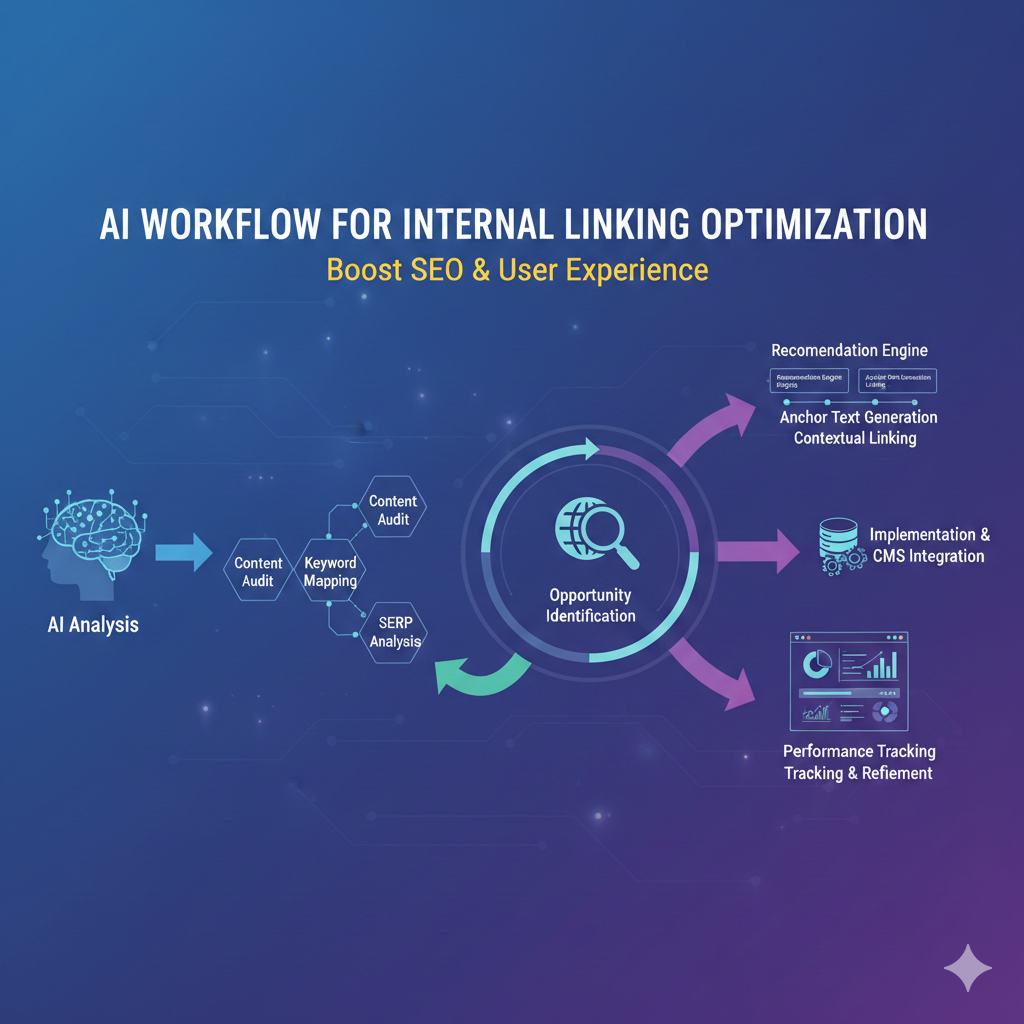
Anchor: “internal linking optimization” → AI Workflow for Internal Linking Optimization
Anchors are descriptive and non-repetitive.
[Pro-Tip]
Keep a simple “change log” per page (date, change, reason). When results shift, causality is clear.
Conversion & UX consideration (natural)
Teams scaling content often pair this workflow with dashboards or editorial trackers to visualize changes, keep approvals tight, and prevent reactive edits.
Image & infographic suggestions (1200 × 628 px)
Featured image prompt:
“Editorial-style diagram showing an AI-assisted publishing and performance tracking loop with QA, monitoring, and iteration checkpoints. Clean, professional design. 1200×628.”
Alt text: AI workflow for publishing and performance tracking with iteration loops
Suggested YouTube embeds
“How to Track SEO Performance After Publishing”
https://www.youtube.com/watch?v=example47
“SEO Iteration: What to Change (and When)”
https://www.youtube.com/watch?v=example48
Frequently Asked Questions (FAQ)
How soon should I track performance after publish?
Within days, but act cautiously.
Can AI predict rankings?
No—only summarize signals.
How often should I iterate?
Every 2–4 weeks, if needed.
Should I change titles quickly?
Only if CTR is clearly weak.
Do visuals affect performance?
Yes, when they clarify intent.
When should I stop iterating?
When gains plateau and intent is satisfied.
Conclusion — Close the loop, grow the asset