Introduction
A prompt engineering learning roadmap matters because random practice rarely leads to reliable skill. Many learners bounce between tutorials, prompt lists, and tools without a clear progression—gaining familiarity but not confidence. From real-world mentoring and project work, the fastest progress comes from sequenced learning: mastering fundamentals first, then layering complexity, and finally building systems that survive real constraints.
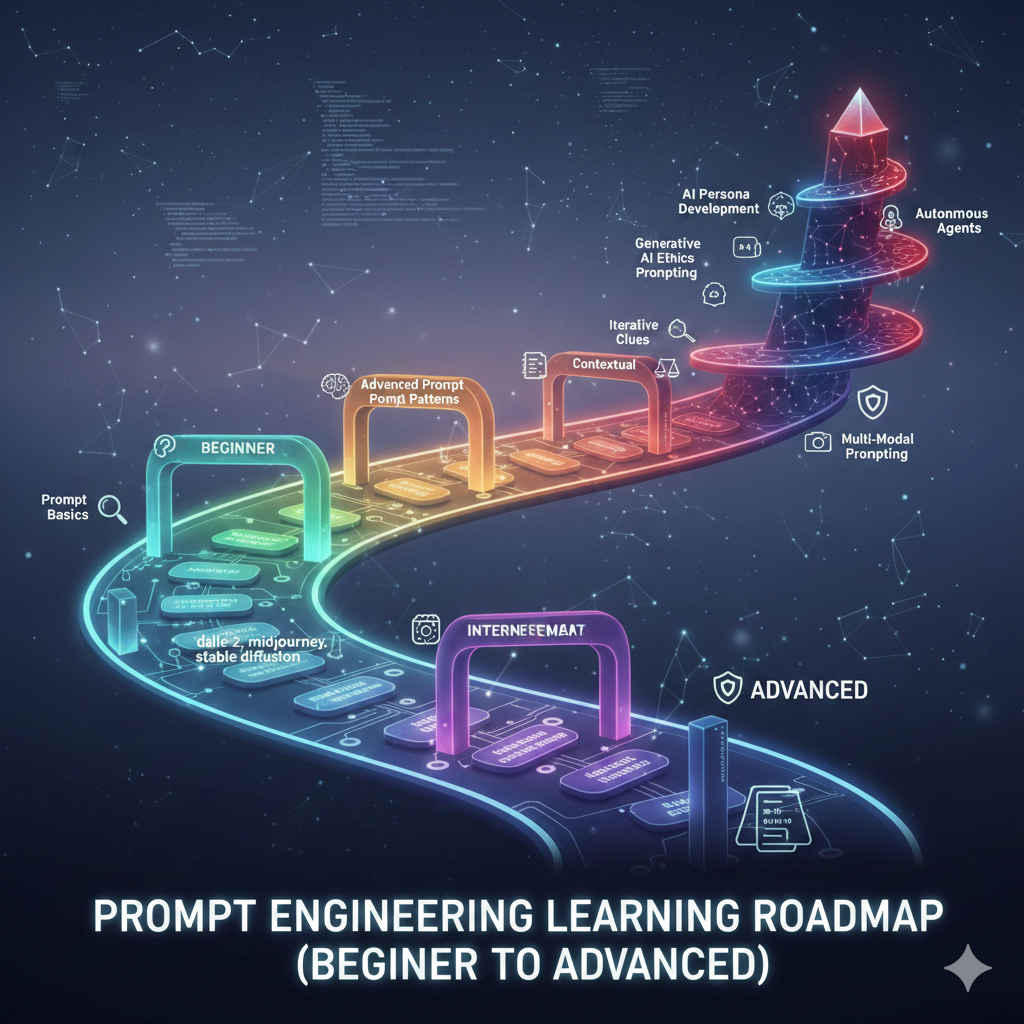
This roadmap lays out a beginner-to-advanced path that prioritizes transferable skills over tool-specific tricks. It explains what to learn at each stage, what to practice, common mistakes to avoid, and how to measure readiness before moving on.
How to use this roadmap (read this first)
Treat stages as milestones, not timelines
Move forward only when outputs are consistent, not flashy
Revisit earlier stages whenever results degrade
Prompt engineering isn’t linear; it’s iterative.
Stage 1: Beginner Foundations (Clarity & Control)
Primary goal: Learn to get predictable, relevant outputs.
What to learn
Instruction vs context vs output format
Specificity without overload
One-task prompts (no multitasking)
What to practice
Rewriting vague prompts into clear ones
Asking for formats (bullets, tables, steps)
Limiting scope explicitly
Readiness check
You can explain why a prompt worked—or didn’t.
Common mistakes
Long prompts packed with rules
Expecting the model to infer missing details
Stage 2: Structured Prompting (Constraints & Formatting)
Primary goal: Shape outputs reliably.
What to learn
Constraints (length, tone, audience)
Output schemas (tables, JSON-like blocks, outlines)
Role assignment (editor, analyst, reviewer)
What to practice
Same task, different constraints
Formatting-first prompts
Separating generation from editing
Readiness check
You can get consistent structure across multiple runs.
Stage 3: Iteration & Debugging (Fixing Failures)
Primary goal: Improve prompts when results are wrong.
What to learn
Diagnosing failure types (scope, ambiguity, bias)
Minimal changes with maximal impact
Asking the model to critique its output
What to practice
“Why did this fail?” prompts
Constraint tightening/loosening
Output comparison prompts
Readiness check
You can recover from bad outputs quickly.
[Expert Warning]
If you can’t explain what changed between two prompt versions, iteration will feel random.
Stage 4: Workflow Building (From Prompts to Systems)
Primary goal: Move from one-off prompts to repeatable workflows.
What to learn
Prompt chaining (generate → review → refine)
Division of labor (human vs AI)
Context handoff between steps
What to practice
Multi-step content workflows
Research → synthesis pipelines
Review gates and validation prompts
Readiness check
You can reuse a workflow across tasks with small tweaks.
Stage 5: Domain Specialization (Applied Expertise)
Primary goal: Adapt prompts to a specific field.
Common domains
Marketing & SEO
Research & analysis
Operations & reporting
Education & training
What to learn
Domain constraints (compliance, accuracy)
Evaluation criteria (what “good” means here)
Risk management (hallucinations, bias)
What to practice
Domain-specific prompts
Real datasets and messy inputs
Stakeholder-friendly outputs
Readiness check
Your prompts reflect domain goals—not generic outputs.
Stage 6: Advanced Systems & Evaluation
Primary goal: Ensure reliability at scale.
What to learn
Prompt libraries and versioning
Output audits and spot checks
Failure logging and refinement cycles
What to practice
A/B prompt comparisons
Reviewer prompts (AI as critic)
Human-in-the-loop checkpoints
Readiness check
You trust outputs because you have safeguards.
Roadmap overview table (quick reference)
| Stage | Focus | Outcome |
| Beginner | Clarity | Relevant outputs |
| Structured | Constraints | Consistent formats |
| Iteration | Debugging | Faster recovery |
| Workflow | Systems | Reusability |
| Domain | Specialization | Practical value |
| Advanced | Evaluation | Reliability |
Information Gain: The missing ingredient in most roadmaps
Most guides focus on what to learn, not when to stop.
From practical use, restraint is an advanced skill. Knowing when a prompt is “good enough” prevents overfitting and wasted time. Advanced practitioners prioritize robustness over perfection.
Unique section — Practical insight from experience
Learners plateau when they chase novelty (new tools, new prompts) instead of depth. The biggest leaps come from repeating the same task with better prompts, not constantly switching tasks.
Depth beats breadth.
Common pitfalls across all stages
Tool-hopping without mastery
Skipping validation and review
Publishing unreviewed outputs
Confusing verbosity with quality
Avoiding these accelerates progress more than any new trick.
Internal linking strategy (planned)
Anchor: “beginner prompt engineering course” → Prompt Engineering Course for Beginners
Anchor: “free crash courses” → Free Prompt Engineering Crash Courses Compared
Anchor: “hands-on prompt projects” → Prompt Engineering Courses with Hands-On Projects
Anchor: “marketing-focused training” → Prompt Engineering for Marketers: Course Guide
Anchors are varied and context-specific.
[Pro-Tip]
Maintain a simple prompt journal: task, prompt version, result quality, fix. Patterns emerge quickly.
Conversion & UX consideration (natural)
For teams formalizing AI use, pairing this roadmap with documentation tools, version control for prompts, or internal playbooks helps translate learning into repeatable organizational knowledge.
Image & infographic suggestions (1200 × 628 px)
Featured image prompt:
“Editorial-style roadmap graphic showing stages of prompt engineering from beginner to advanced, with milestones and skills. Clean, educational design. 1200×628.”
Alt text: Prompt engineering learning roadmap from beginner foundations to advanced workflows
Suggested YouTube embeds
“Prompt Engineering Roadmap: Beginner to Advanced”
https://www.youtube.com/watch?v=example35
“How to Level Up Prompt Engineering Skills”
https://www.youtube.com/watch?v=example36
Frequently Asked Questions (FAQ)
How long does it take to follow this roadmap?
Progress depends on practice, not time.
Can beginners jump to advanced stages?
They can, but results are unstable.
Do I need coding to advance?
No—clear thinking matters more.
Should I specialize early?
Start broad; specialize after workflows stabilize.
How do I know I’m ready to move on?
When outputs are consistent and explainable.
Does this roadmap apply across tools?
Yes—it’s tool-agnostic by design.
Conclusion — A roadmap built for real progress
A prompt engineering learning roadmap works when it emphasizes clarity, iteration, and systems—not shortcuts. From real-world experience, learners who follow staged progression build skills that transfer across tools and domains.
Use this roadmap to guide practice, avoid common traps, and turn experimentation into dependable capability.